

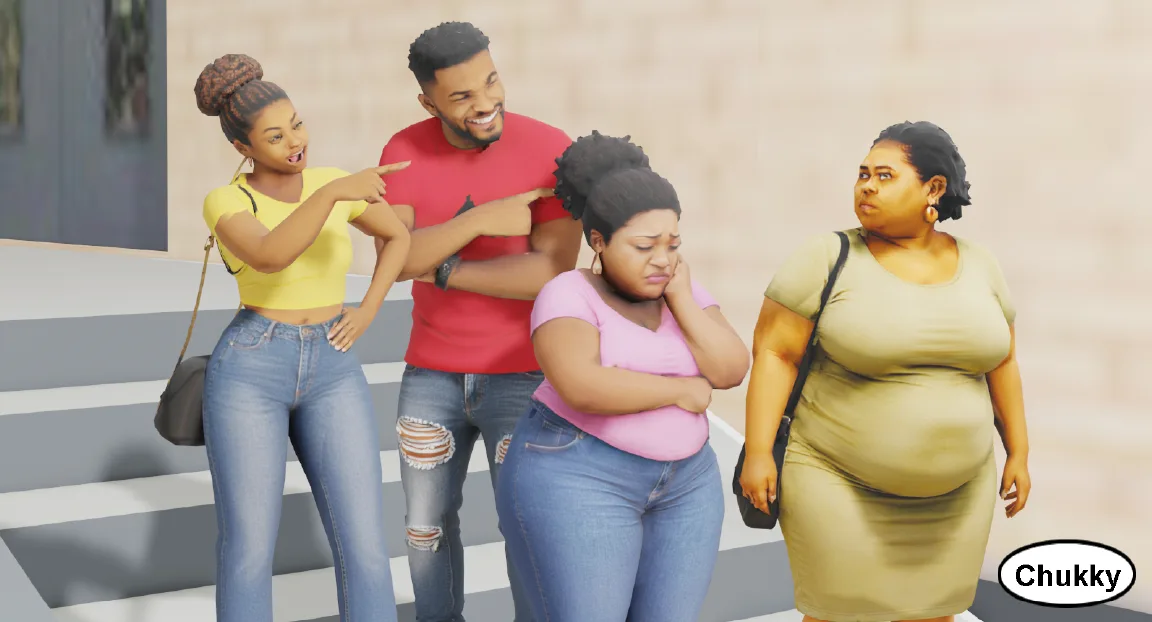
For many, body-shaming is far more than an occasional insult; it is a relentless assault on dignity played out in classrooms, family gatherings, workplaces, crowded buses and across the unforgiving landscape of social media. Behind the laughter, nicknames and “harmless” jokes lie stories of rejection, shattered self-esteem, lost opportunities and silent emotional scars. DANIEL AYANTOYE chronicles the painful realities of people whose greatest struggle is living in bodies society refuses to accept
At 27, Iyanu Olawale had convinced herself that a new job would be the beginning of a new life.
For months, the Lagos-based office assistant endured relentless humiliation at the travel and tourism company where she worked. Every workday came with another remark about her body size, while every insult chipped away at her confidence.
So when an Information Technology firm in Ikeja invited her for an interview, she clung to the opportunity like a lifeline.
For a brief moment, she believed she had found her escape.
“I got there, they interviewed me and asked all the questions. I told them I could do the job. I left feeling hopeful and waited for their response, but they never called me back,” she recalled.
The rejection hurt, but the reason behind the silence shattered her.
Olawale, whose name has been changed to protect her identity, told Saturday PUNCH that the friend who helped her submit the application later revealed why the company didn’t reach out to her.
“They told him I wouldn’t be able to do the job because I was overweight. I really felt bad,” she said tearfully.
It was not the first time her body had spoken louder than her abilities.
Olawale still remembers walking into her current office on her very first day, expecting a warm welcome. Instead, the managing director looked her over and asked a question that has stayed with her ever since.
‘‘Why are you this fat?’’
“I was deeply hurt. I wasn’t the one who created myself,” Olawale said.
Today, she describes her workplace as “a nightmare.”
According to her, the daily comments have left her feeling trapped between emotional abuse and unemployment.
“Getting another job is a problem, and now I can’t leave where I’m being tormented every day. What will I do? I now suffer from depression. Please help me if you can,” she appealed.
The ridicule does not end when she leaves the office.
Olawale said ordinary journeys on public transport have become another source of humiliation, with some commercial drivers insisting she should pay for two seats because of her size.
In her neighbourhood, she endures whistles, mocking chants and unsolicited comments from young men.
“Sometimes I just feel like staying at home and not going out. Everywhere I pass, people are looking at me.
“Area boys will whistle and say all sorts. It is frustrating. I’m not even that oversized. I’ve seen people much bigger than me. I don’t eat too much; I eat once a day most times. This is just how I am,” she said.
As Olawale continues to search for another opportunity, one fear refuses to leave her: what if the next employer sees her body before seeing her competence?
“That was the last job I ever applied for”
Olawale’s story is one of many.
For 32-year-old Toyin Faronbi, years of being judged because of her size changed the direction of her working life.
In 2014, she applied during a nationwide recruitment exercise by the Nigeria Immigration Service.
Faronbi travelled to Osun State, hopeful that merit would determine her future. Instead, she said, an officer dismissed her before the process had barely begun.
“One of their officers looked at me and said, ‘With your size, they won’t take you.’”
She was eventually unsuccessful.
The experience broke something inside her.
“That was the last time I ever applied for jobs. I now do buying and selling just to earn a living,” Faronbi said.
But employment was only one part of the struggle.
Faronbi said even routine journeys have become emotionally draining.
“A few days ago, I was in a bus coming back from Oshodi. A woman wanted to sit beside me and kept saying, ‘Shift,’ while showing me attitude until we got to our destination. Things like this happen every day. People say it jokingly, but inside you, it hurts,” she lamented.
‘Harmless jokes’
In Nigeria, body-shaming rarely arrives as outright abuse. More often, it comes wrapped in laughter.
A relative asks why someone has become “too fat.” A colleague wonders whether a slimmer person is sick. Strangers comment on height, skin colour, scars, facial features or disability as though another person’s body were public property.
Because the remarks are delivered with a smile, victims are often expected to laugh along.
Social media has amplified the culture. A single photograph can attract hundreds of jokes and insults about someone’s appearance, while those who complain are quickly silenced with familiar refrains like, “We’re only joking,” or “Don’t be too sensitive.”
Yet psychologists warn that repeated ridicule is anything but harmless. It erodes confidence, pushes people into isolation and gradually shapes how they see themselves and their place in society.
For Olawale and Faronbi, what others dismissed as harmless banter became barriers to employment, freedom and self-worth.
And where the joke ends, the damage begins.
Mocked for living with albinism
For Lagos entrepreneur, Victoria Adesanya, discrimination has followed her long before she entered the labour market.
Living with albinism, she believed education and vocational training would speak louder than appearance. After secondary school, she studied catering and equipped herself with practical skills, hoping they would improve her chances of finding work.
Instead, interview after interview ended with the same familiar silence.
“Anytime I went for an interview, they would praise my performance and my results, promise to call me back, and that would be the end,” Adesanya said.
Outside the workplace, the humiliation continued.
She recalled travelling in a commercial bus in Lagos when another passenger, noticing she was about to alight at Ikeja, mocked her in Yoruba.
“Òrìsà fé bòlè,” meaning, “a deity wants to alight.”
“I felt embarrassed,” she said.
According to Adesanya, children also ridicule her openly on the streets, often with the approval or silence of the adults around them.
“When I’m walking on the road, children will be singing and mocking me. Instead of their parents correcting them, some of them support it,” Adesanya lamented.
Even protecting herself from the sun attracts ridicule.
People living with albinism are particularly vulnerable to sun damage, making umbrellas a medical necessity rather than a fashion accessory. Yet Adesanya said strangers still question her.
She said, “Around Iyana-Ipaja, people kept asking me if it was raining because I was using an umbrella against the sun. On another occasion, a commercial bus driver asked if I could even see. I asked him, ‘Are you the one who brought me into this world?’
Her experience mirrors that of Akwa Ibom State Governor Umo Eno, who has spoken publicly about growing up with albinism and enduring years of bullying, rejection and body-shaming because of his appearance.
Reflecting on his childhood in an August 2025 post on X, Eno said those painful experiences shaped his determination to recognise, support and encourage people living with albinism.
Dwarfism draws mockery
For many Nigerians living with dwarfism, mockery is not an isolated incident but an everyday reality.
John Adewuyi knows that reality all too well.
The ridicule, he said, has become so frequent that he has almost learnt to expect it whenever he steps outside his home.
“It has become normal. No matter how you are, people will still step on your toes,” he said.
Even something as ordinary as boarding a commercial taxi can become an exercise in humiliation.
“When I want to take a taxi, the way some people behave is irritating,” he said.
The prejudice began long before adulthood. As a student, Adewuyi said strangers often assumed he was a child because of his height until they heard him speak.
“When I was in college, I had a lot of friends. Some children would think we were mates, but once they heard my voice and saw the way I behaved, they would say, ‘He is baba.’”
Celebrities under social media fire
For celebrities, body-shaming rarely stays in whispers. It unfolds before millions.
Public figures are routinely scrutinised over their weight, body shape, skin complexion and facial features, with social media giving strangers the freedom to ridicule appearances from behind anonymous accounts.
Comedienne and actress Chioma Omeruah, popularly known as Chigul, has spoken openly about the emotional toll of constant comments about her weight, admitting that the insults still hurt, especially on difficult days.
Actress and filmmaker Etinosa Idemudia has similarly revealed that years of criticism about her stomach ignored one important fact: she lives with polycystic ovary syndrome, a medical condition many of her critics knew nothing about.
Singer Omawumi Megbele has also recalled being mocked as a child because of her facial features, saying the ridicule affected her confidence and once pushed her towards using heavy make-up to conceal what she had come to see as flaws.
The mockery that led to surgery
For social media influencer and comedian Aloma Isaac Junior, better known as Zicasloma, years of ridicule eventually changed the way he saw himself.
In a 2025 video, he recounted how his siblings and friends mocked the shape of his nose throughout his childhood. What began as teasing gradually became a source of deep insecurity.
The comments lingered for years until he eventually underwent rhinoplasty surgery to alter his appearance.
When changing your body changes nothing
Body-shaming, however, often refuses to end even after the body changes.
Actress Eniola Badmus has publicly documented her remarkable weight-loss journey, revealing that she reduced from 170kg to 83kg over five years. Yet, instead of ending the criticism, she said it merely changed its direction.
In an Instagram post in July, she wrote: “But here’s what breaks my heart… The same people who body-shamed me when I was plus-size are the same people body-shaming me now that I’ve lost the weight. What exactly do you want from me?”
Her experience underscores a painful truth: for many victims, the problem is not their bodies but a society determined to police them.
The data speak
Nigeria has no nationally representative data measuring the prevalence of body-shaming or its psychological impact. However, available research suggests appearance-related distress and bullying are widespread.
A 2015 study published in the Journal of Epidemiology and Global Health found that 62 per cent of young Nigerian adults experienced body-shape dissatisfaction.
The figure rose to 71 per cent among women, compared with 52 per cent among men.
Similarly, a 2023 study in the Journal of Taibah University Medical Sciences reported that 51.9 per cent of respondents had experienced at least one form of bullying, while 27.9 per cent admitted to bullying others.
A 2024 PLOS ONE study further found that 11.3 per cent of Nigerian adolescents had experienced major depression within the previous year, identifying bullying as an independent predictor of depressive disorders.
Adolescents who were bullied had nearly eight times the odds of developing depression.
The emotional burden is compounded by the realities of an increasingly competitive labour market.
According to the National Bureau of Statistics, Nigeria’s unemployment rate stood at 4.3 per cent in the second quarter of 2024, with young people aged 15 to 34 facing higher unemployment levels, making appearance-based discrimination an additional barrier for many job seekers.
“Body-shaming is unacceptable”
The National President of the Albinism Association of Nigeria, Mrs Josephine Omolola, described body-shaming as an assault on dignity rather than appearance.
She stressed that albinism is a genetic condition affecting pigmentation and has no relationship with intelligence, competence or character.
“The consequences of body-shaming and discrimination affect education, employment, relationships, confidence and participation in society,” Omolola said.
She urged government, schools, employers, religious institutions, families and the media to move beyond sympathy towards genuine inclusion.
Omolola also called for stricter enforcement of laws protecting persons with albinism and stronger penalties for bullying, harassment, discrimination and hate speech.
Experts warn of lasting psychological scars.
Professor of Clinical, Counselling and Rehabilitation Psychology at Lagos State University, Deborah Adewuyi, said the damage caused by body-shaming often extends far beyond the moment the words are spoken.
She explained that persistent ridicule can gradually erode self-esteem, self-confidence and self-assertiveness, leaving victims vulnerable to anxiety and depression.
According to her, individuals must learn to recognise that their abilities outweigh their appearance.
“What you possess, your skills and how you express them, is what matters. You can be fat or slim, but your ability to communicate your skills is important. Know yourself and understand your environment,” she said.
Professor of Psychology at Ekiti State University, Adebayo Ayinla, added that while certain professions may legitimately require specific physical attributes, such requirements should never be used to justify arbitrary discrimination.
Using modelling as an example, he noted that appearance can sometimes form part of a job specification, but warned against extending such reasoning to occupations where body size, height or skin condition has no bearing on performance.
“It is about the requirements of the job,” the don said.
He cautioned that although some medical conditions, including albinism, may present visual limitations relevant to highly specialised occupations, that should never become an excuse for excluding qualified people from employment generally.
“While it is not every job they can fit in, discriminating against them for jobs they can do is not good enough,” Ayinla said.
HR expert urges merit-based hiring.
Human resource expert and Lead Consultant at RecruitTech HR Solution, Mayowa Ojo, said recruitment should be driven by competence rather than appearance, warning employers against allowing prejudice to influence hiring decisions.
According to him, the central question during recruitment should be whether an applicant can perform the duties of the role, not whether the person is fat, thin, short, tall or living with albinism.
“For me, recruitment should be about whether the person can actually do the job, not whether the person is fat, thin, short, tall or has albinism,” Ojo said.
He acknowledged that certain occupations may legitimately require specific physical abilities for safety or operational reasons, but stressed that such criteria must be based on the actual demands of the job rather than stereotypes or personal bias.
Ojo also warned employers against normalising jokes about an employee’s weight, height or physical appearance, saying such remarks can gradually erode confidence and reduce productivity.
“People come to work to contribute and earn a living, not to have their bodies constantly discussed,” he added.
Principals: Body-shaming is prohibited in schools
The National President of the All Nigeria Confederation of Principals of Secondary Schools, Dr Robert Okorie, said bullying and body-shaming are prohibited in secondary schools nationwide, with offenders liable to disciplinary action.
He explained that students who engage in such behaviour often do so discreetly because they are aware that it attracts punishment.
“Such things have been banned in schools. Those who bully and body-shame people do it secretly because they know they would be punished,” Okorie said.
According to him, students found guilty of bullying are suspended, while their parents are invited to the school and required to sign an undertaking. A repeat offence, he added, could result in expulsion.
Victims can seek justice — Lawyer.
A legal practitioner, Tolu Babaleye, said victims of body-shaming and appearance-based discrimination are not without legal protection, noting that such conduct could amount to a violation of their fundamental rights.
He said Chapter Four of the Constitution guarantees every Nigerian the right to dignity and freedom from discrimination, adding that body-shaming may breach both rights depending on the circumstances.
Babaleye advised victims who have evidence of discriminatory treatment to pursue legal redress.
“By virtue of Chapter Four of the Constitution, there are fundamental rights to the dignity of the human person and to freedom from discrimination. If you are body-shamed, those rights may have been violated. If you go to court with your evidence, you can get justice,” he said.